
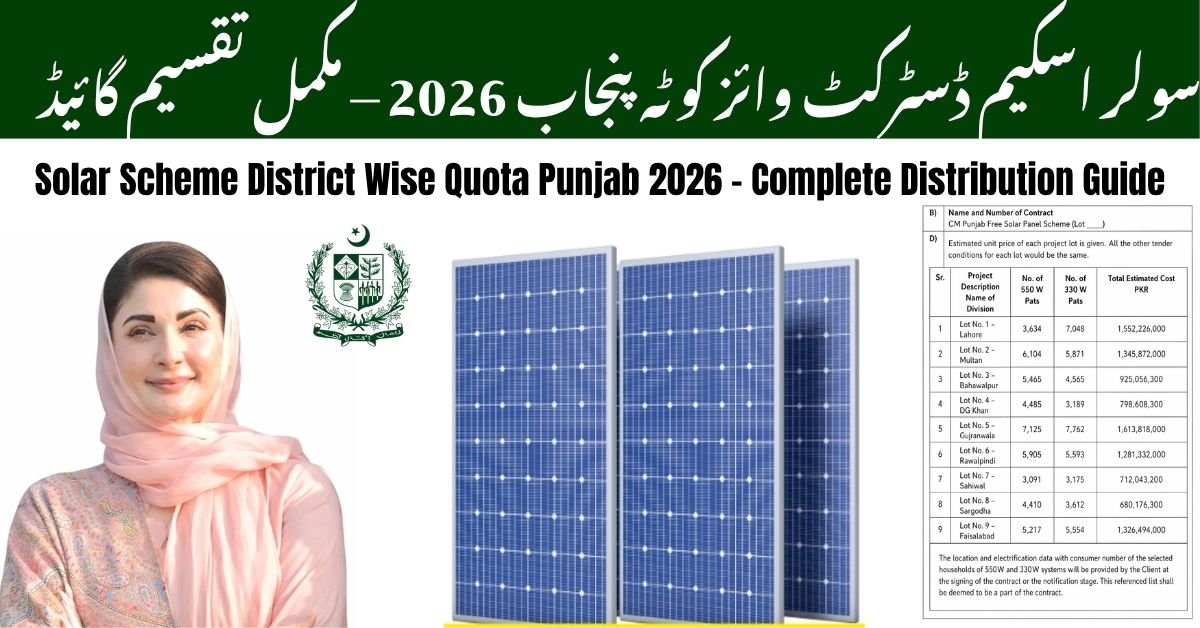
The Punjab Solar Scheme 2026 is a government programme that gives free or low-cost solar systems to families. Its aim is to help people lower their electricity bills and reduce load-shedding by using clean energy.In this scheme, solar systems are given through a district-wise quota system. This means every district in Punjab gets a fixed number of solar panels based on its population, demand, and need. Selection is not random.This system makes sure all districts get a fair share. Big districts may get more solar systems, while smaller districts also get their part.In simple words, the Solar Scheme District Wise Quota Punjab 2026 is a fair system that divides solar systems equally among all districts.
Solar Scheme District Wise Quota Punjab 2026– Quick Highlights
| Feature | Details |
| Program Name | Punjab Solar Scheme 2026 |
| Managed By | Government of Punjab |
| Purpose | Free/Subsidized Solar Systems |
| Target Audience | The Low-income households |
| Quota System | District-wise allocation |
| Selection Method | Balloting (Draw System) |
| Application Check | Online Portal / SMS |
| Installation | After selection approval |
What is the Solar Scheme Punjab 2026?
The solar scheme is a government program that helps low-income families and reduce their electricity bills by providing solar panel systems.
Key features:
- Free or subsidized solar systems
- Priority for low-income families
- Transparent selection through balloting
- District-based distribution
What is the District Wise Quota?
District-wise quota means that each district in Punjab is allocated a fixed number of solar systems.
Instead of selecting applicants randomly across the province, the government ensures:
- Fair distribution
- Equal opportunity for all districts
- Balanced regional development
لاہور
زیادہ آبادی کی وجہ سے بڑا کوٹہ مختص
فیصل آباد
انڈسٹریل علاقوں کو ترجیح دی گئی
ملتان
دیہی اور شہری دونوں علاقوں میں تقسیم
راولپنڈی
درمیانی سطح کا کوٹہ فراہم کیا گیا
How is Quota Decided?
The quota is not random. It is based on several factors:
1. Population Size
Districts with higher populations get more quota.
2. Number of Applications
More applications = higher allocation chances.
3. Poverty Level
Underdeveloped areas may receive additional preference.
4. Government Policy
Special focus areas may get extra quota.
Estimated District Wise Distribution
| District Type | Quota Level |
| Large cities | High |
| Medium districts | Medium |
| Small districts | Limited |
Examples:
- Lahore, Faisalabad → Higher quota
- Multan, Bahawalpur → Medium quota
- Smaller districts → Lower quota
Why Some Districts Get More Quota
This often creates confusion among applicants.
Reasons include:
- Higher electricity demand
- More registered applicants
- Larger population
- Urban infrastructure priority
This does not mean the small districts are ignored. They will still and get their share based on their size and need.
City Wise Expected Solar Distribution (Punjab 2026)
| City / District | Expected Quota Level |
| Lahore | Very High |
| Faisalabad | High |
| Rawalpindi | High |
| Multan | High |
| Gujranwala | Medium-High |
| Sialkot | Medium |
| Bahawalpur | Medium |
| Sargodha | Medium |
| Sheikhupura | Medium |
| Rahim Yar Khan | Medium |
| Dera Ghazi Khan | Low-Medium |
| Muzaffargarh | Low-Medium |
| Okara | Medium |
| Kasur | Medium |
| Smaller districts | Low |
Note: These are expected levels, not final government numbers.
How Solar Systems Will Be Distributed
The process is simple and fair:
- First, applications are collected from all districts
- Each district gets a fixed quota
- Eligible applicants are shortlisted
- Balloting (draw system) is held
- Selected people are announced
- Solar systems are installed after verification
How to Check Your District Quota
The quota is not random. It is based on several important factors that help ensure fair distribution across all districts. These factors include:
1. Official Portal
- Visit government solar scheme website
- Enter CNIC
- View application and district status
2. Announcement Lists
- Government releases district allocation updates
- Available via official sources
3. SMS or Helpline
- Some schemes provide status via SMS
- Helpline can confirm selection info
Selection & Balloting Process
After quota is assigned:
- Applications are verified
- Eligible candidates are shortlisted
- Balloting (digital draw) is conducted
- Selected candidates are notified
This ensures transparency and fairness.
Common Reasons for Not Getting Selected
Many applicants are eligible but still not selected.
Common reasons:
- Limited district quota
- High number of applicants
- Incomplete application
- Verification issues
Common Issues in Solar Scheme & Their Solutions
Problem | Possible Reason | Solution |
| Not selected in balloting | Limited district quota | Wait for next phase or reapply |
| CNIC not found | Incorrect or unregistered data | Re-check CNIC and update details |
| Application rejected | Incomplete or Wrong information | Submit correct information again |
| No status update | System delay or verification in process | Check again after few days |
| District quota full | High number of applicants | Apply early in next round |
| SMS not received | Wrong mobile number | Update contact details |
| Portal not working | Server issue or heavy traffic | Try during off-peak hours |
| Verification pending | Documents not fully verified | Contact helpline or office |
Tips to Improve Selection Chances
- Submit accurate CNIC details
- Complete application properly
- Apply early
- Stay updated with announcements
The quota cannot be changed,and the correct application increases your chances.
How Distribution Works
Solar systems are not fixed numbers per city. Instead:
- Total systems are first calculated
- Then divided among districts
- Big cities get larger share
- Small districts get smaller but equal opportunity
Simple Understanding
- Big cities = more solar systems
- Medium districts = balanced share
- Small districts = limited but fair share
Important Note
The final quota list is officially announced by the Punjab Government, and it may change depending on:
- Budget
- Number of applicants
- Policy updates
Final Thoughts
ThePunjab Solar Scheme 2026 uses a district-wise quota system to make sure and the distribution is fair across all areas.Each district is given a fixed number of solar system slots based on its population and needs. Larger districts may receive more quota, while smaller districts receive less.After the quota is set, applications are processed through a transparent balloting system. In this system, eligible applicants are selected randomly within each district.This ensures that every applicant gets an equal and fair chance of selection, regardless of their location.
FAQ Section
Q1: What is the district-wise quota in the solar scheme?
Ans: It is the fixed number of solar systems allocated to each district.
Q2: How is quota calculated?
Ans: Based on population, applications, and government policy.
Q3: Can I apply in another district?
Ans:No, quota is based on your registered district.
Q4: Why was I not selected?
Ans: Due to the limited quota or the high number of the applicants.
Q5: Is the quota the same every year?
Ans: No, it may change based on policy updates.