
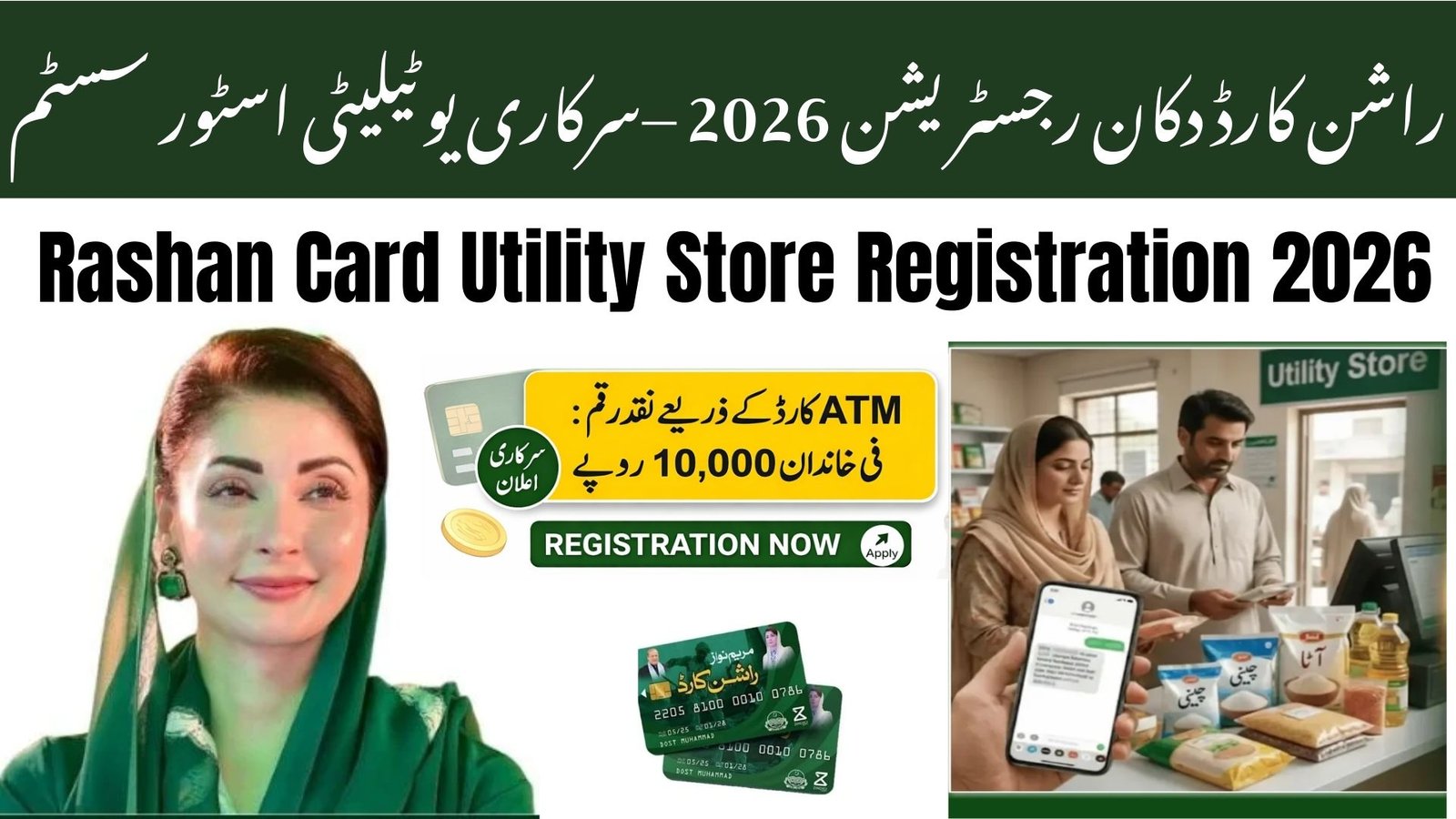
Rashan Card Store Registration 2026 is a major step by the government to expand subsidized food distribution through local utility stores and kiryana shops. Under this system, small retailers can register themselves to provide discounted essential items to deserving families. The aim is to bring relief closer to people by using neighborhood stores instead of limiting support to selected centers only. Through digital verification, CNIC-based registration, and SMS services , shopkeepers can become part of the national subsidy network. This model not only improves access to affordable food but also supports small businesses by increasing customer flow. The Utility Store System ensures transparency, fast verification, and direct benefit delivery. By integrating Ehsaas Rashan support, biometric SIM verification , and PMT score checks, the program ensures that only eligible families receive discounts while registered stores operate in a monitored environment.
Form Highlights – Store Registration Overview
| Feature | Details |
| Program Name | Rashan Card Store Registration 2026 |
| System | Utility Store System (USC Integrated) |
| Registration Method | 5566 SMS Registration + Online Verification |
| Required ID | 13-Digit CNIC |
| Store Type | Kiryana Store / Utility Store / USC Franchise |
| Eligibility Check | PMT Score Under 40 |
| Verification | OTP + SIM Biometric Verification |
| Subsidy Offered | Up to 40% Rashan Discount to Beneficiaries |
| Registration Fee | No Registration Fee (Free USC Enrollment) |
| Bank Requirement | NBP Account for Franchise Settlement |
| Purpose | Expand Subsidy Distribution Through Local Stores |
What is Rashan Card Store Registration?
Rashan Card Store Registration is a system where local shopkeepers are authorized to distribute subsidized food items under the government relief program. Instead of opening new centers, the government partners with existing stores to create a wider and faster distribution network.
This system allows:
- Quick access to ration for families
- Digital verification of purchases
- Transparent subsidy adjustment
- Local economic support for small businesses
How the Utility Store System Works
The Utility Store System connects registered shops with the central subsidy database. When an eligible family visits a registered store, their CNIC is verified digitally, and the discount is applied automatically.
The process includes:
- Store registration and approval.
- CNIC-based customer verification.
- Real-time eligibility confirmation.
- Discounted sale recorded in the system.
- Subsidy amount settled through bank integration.
This ensures there is no manual handling, no duplication, and no misuse of funds.
8070 SMS Registration Method
Shopkeepers and beneficiaries interact with the system through the 8070 SMS service.
Basic Process:
- Open SMS on registered mobile number.
- Type CNIC (without dashes).
- Send to 8070.
- Receive eligibility or registration response.
- Complete OTP verification if required.
This simple method allows even rural shopkeepers to join without complicated procedures.
Who Can Apply for Store Registration?
The program is open to:
- Small kirtana store owners
- Utility store operators
- USC franchise applicants
- Registered retail businesses
- Shops with active SIM in owner’s name
- Stores located in eligible districts
The goal is to build a trusted retail network across urban and rural areas.
Eligibility Criteria for Stores
To qualify for Rashan Card Store Registration:
- The owner must have a valid 13-digit CNIC.
- SIM must be biometrically verified.
- The shop must be operational and accessible to the public.
- Applicants must pass digital verification checks.
- Must be willing to provide subsidized items at fixed rates.
- Bank account (NBP preferred) required for settlement.
Role of PMT Score in the System
The PMT (Proxy Means Test) score is used to verify which families qualify for subsidy.
- Families with a PMT score under 40 receive support.
- Stores do not decide eligibility the system verifies automatically.
- This prevents favoritism or manual selection.
Subsidy Model for Registered Stores
Registered stores provide essential items such as:
- Flour
- Sugar
- Pulses
- Cooking oil
- Rice
Eligible families receive up to 40% discount, while the remaining amount is reimbursed to the store through the government subsidy channel. This protects both the customer and the shopkeeper.
USC Franchise Opportunity
Shopkeepers can also apply for USC franchise integration , which offers:
- Official partnership recognition
- Digital billing system
- Government-backed supply chain
- Increased customer trust
- Stable transaction volume
There is no registration fee, making it easier for small businesses to join.
OTP and SIM Verification Process
Security is ensured through:
- OTP verification sent to registered number
- SIM ownership confirmation
- CNIC validation through national database
This prevents fake registrations and ensures only genuine retailers participate.
Benefits of Rashan Card Store Registration
For Families:
- Nearby access to subsidized food
- Reduced travel and waiting time
- Transparent price reduction
- CNIC-based verification ensures fairness
For Shopkeepers:
- Increased daily sales
- Government partnership credibility
- Digital payment settlement
- No franchise fee burden
- More customer trust and retention
For Government:
- Wider distribution network
- Controlled subsidy leakage
- Real-time monitoring
- Efficient relief delivery
What is the Importance of Rashan Card Store Registration 2026?
Rashan Card Store Registration 2026 is very important because it helps poor families get food easily, especially in Ramzan. Earlier, people had to go to big government centers to get relief. These centers were far away, crowded, and people had to wait in long lines. Now, with this program, families can get cheap and important food items from nearby kiryana stores. This makes it faster and easier for everyone. The program is also very fair. It uses CNIC numbers to check who really needs help. This means only deserving families get the benefits. No one can take more than they should, and no one who is not eligible can get it. This makes the system honest and trusted. Small shop owners also benefit from this program. When people come to their shops to get rashan, the shops get more customers. Shopkeepers also become part of a government-supported system. This way, the program not only helps poor families but also supports local businesses.
Another good thing about this program is that it is very transparent. All the transactions are recorded digitally. This means the government can see in real time who got the food and where it went. This reduces corruption, cheating, and mistakes. Families can get help on time, and the government can make sure everything is correct. Overall, Rashan Card Store Registration 2026 is a very smart program. It gives poor families food with respect and ease, helps small shops grow, and makes the relief system honest and transparent. Families don’t have to travel far or wait for a long time, shopkeepers get more business, and the government can keep everything organized. It is a program that helps everyone in the community.
Common Mistakes to Avoid During Registration
Many applicants face delays because of simple errors:
- Using an unregistered SIM not linked to CNIC.
- Sending incorrect CNIC format in SMS.
- Providing inactive shop details.
- Entering wrong bank information.
- Attempting multiple registrations from the same ID.
- Ignoring OTP verification step.
- Applying without biometric SIM confirmation.
Avoiding these mistakes ensures faster approval.
Challenges in Implementation
While the system is designed for ease, some issues may occur:
- Network delays in rural verification.
- Lack of awareness among small shopkeepers.
- Incorrect PMT data causing eligibility confusion.
- Technical delays in OTP delivery.
- Bank detail mismatches during settlement.
These challenges are being addressed through system upgrades and awareness campaigns.
How This System Supports Local Economy
By including kirtana stores in subsidy distribution, the program:
- Strengthens small retail businesses.
- Keeps financial activity within local communities.
- Creates a sustainable welfare-delivery model.
- Reduces dependency on centralized distribution centers.
This is not just a relief effort — it is an economic support structure.
Conclusion
Rashan Card Store Registration 2026 is transforming the way relief reaches people by turning local shops into authorized distribution partners. Through the Utility Store System, digital verification , and SMS-based registration, the program ensures that subsidies reach deserving families quickly and transparently. At the same time, it empowers small retailers by integrating them into a national welfare network. With no registration fee, simple CNIC verification, and structured reimbursement, the model creates a balanced system where both citizens and businesses benefit. As awareness grows and more stores join, this initiative is expected to make subsidized food access easier, faster, and more reliable across the country.
Note:
Our website provides information about government schemes and public welfare programs. Whenever a new update or policy change is announced, this article will be updated to keep readers informed with the latest details.
FAQs – Rashan Card Store Registration 2026 – Utility Store System
1. What is Rashan Card Store Registration 2026?
Rashan Card Store Registration 2026 is a system that allows utility stores and local kiryana shops to register as authorized distribution points to provide subsidized rashan to eligible families.
2. Who can apply for store registration?
Small grocery shop owners, utility store operators, and registered business holders who meet the government criteria can apply for registration.
3. Is there any registration fee for joining the Utility Store System?
No, the registration process is completely free. Applicants are not required to pay any fee for approval.
4. What documents are required for store registration?
Applicants usually need a valid CNIC, registered mobile SIM in their own name, shop ownership or rental proof, and basic business details.
5. How does the verification process work?
After applying, authorities verify CNIC details, SIM ownership, and business information. In some cases, biometric verification may also be required.
6. What benefits do registered stores receive?
Registered stores become official partners in the subsidy program, receive government-supplied items, and attract more customers due to discounted rashan availability.
7. Can a small kiryana shop participate in this program?
Yes, small neighborhood shops are encouraged to participate so that relief can reach people at the local level.
8. How do families receive discounts through these stores?
Eligible families show their CNIC or registered details at approved stores to receive rashan items at subsidized rates.
9. What is the required eligibility score for participation in the program?
Stores serve families whose PMT score falls within the government-defined poverty criteria, ensuring support reaches deserving households.
10. How long does approval take after applying?
Verification and approval may take a few days to a few weeks, depending on document accuracy and inspection requirements.
11. Can a registration be rejected?
Yes, applications may be rejected if documents are incomplete, business information is incorrect, or verification requirements are not met.
12. What should applicants do if their application is delayed?
They should check their submitted details, ensure their SIM is registered in their own name, and wait for confirmation from the authorities.
13. Is biometric verification mandatory for store owners?
In many cases, biometric confirmation is required to ensure transparency and prevent misuse of the subsidy system.
14. Can a store operate in the program without proper registration?
No, only officially approved stores can distribute subsidized rashan under this system.
15. Why is this system important for the public?
It creates a transparent distribution network, reduces shortages, and ensures that relief items reach deserving families through trusted local stores.